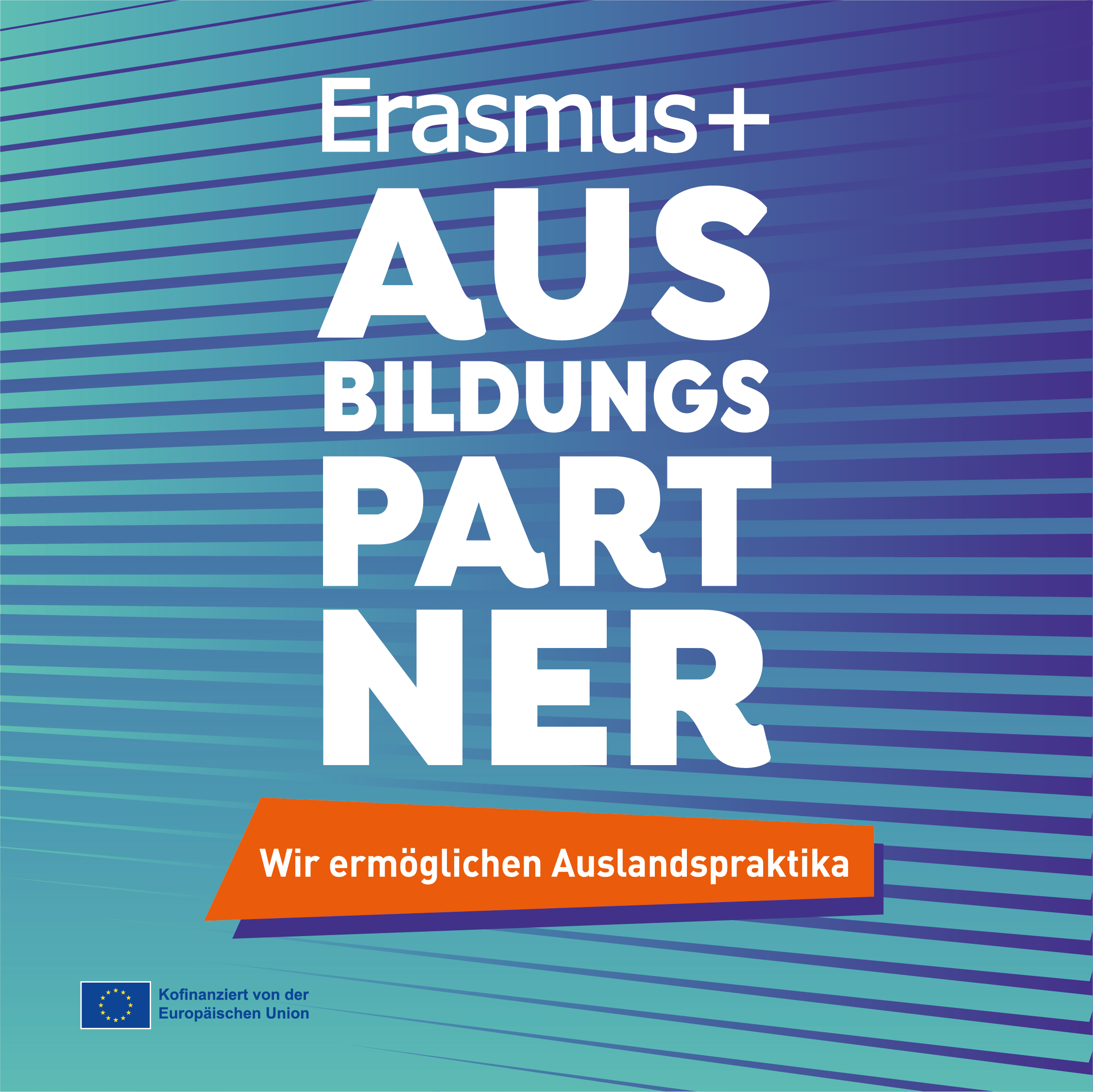


[…] © B or ea la /A do be St oc k. co m Das Label als sichtbares Zeichen für teilnehmende Unternehmen Erasmus+ Ausbildungspartner © NA beim BIBB 2 Internationale Berufserfahrungen werden in unserer globalen Wirtschaft immer wichtiger. Das europäische Programm Erasmus+ fördert den Erwerb internationaler Berufs- und Sprachkompetenzen, bietet aber auch kulturellen und persönlichen Mehrwert. Als teilnehmender Ausbildungsbetrieb entsenden Sie Ihre Azubis zu Partnerbetrieben im europäischen Ausland und machen dadurch internationale Berufserfahrung erst möglich. Als sichtbares Zeichen der Wertschätzung möchten wir Ihrem Unternehmen das von uns neu entwickelte Erasmus+ Ausbildungspartnerlabel zur Verfügung stellen. Die Idee dahinter © NA beim BIBB 3 Durch die sichtbare Präsentation des Erasmus+ Ausbildungspartnerlabels auf Ihrer Website, im Eingangsbereich oder in Schulungsräumen, positionieren Sie sich als attraktiver Arbeitgeber mit internationaler Ausrichtung und werben zugleich für die Auslandspraktika des Programms Erasmus+. Nutzen Sie dieses Label auch als Attraktivitätsfaktor für Ihr Ausbildungsmarketing und um motivierte Nachwuchskräfte auf Ihr Unternehmen aufmerksam zu machen. Denn nicht nur für die Azubis ist die Teilnahme an Erasmus+ ein klarer Mehrwert auf dem internationalen Arbeitsmarkt. Ihre Vorteile liegen klar auf der Hand © NA beim BIBB 4 So sieht das neue Label aus © NA beim BIBB 5 Sichtbarkeit im Unternehmen Portalschild Format A4 (Aludibond oder Kunststoff). Wird kostenlos als physisches Schild zur Verfügung gestellt. Alternativ: Türkleber (A4 oder A5) 1. 2. Foyer, Konferenzraum, Schulungsraum: L-Banner (ähnlich Roll up) Social Media Visuals Instagram, Facebook und X Website-Footer: Label mit Aktivlink Auf Website: www.na-bibb.de/ ausbildungspartnerlabel 3. 4. 5. http://www.na-bibb.de/ausbildungspartnerlabel © NA beim BIBB 6 Projektion auf das Unternehmensportal Portalschild Format A4 (Aludibond oder Kunststoff) © NA beim BIBB 7 Projektion auf die Eingangstür Alternativ: Türkleber (Format A4 oder A5) © NA beim BIBB 8 Präsenz im Unterenehmen (Foyer, Konferenz-, Schulungsraum Preiswertes L-Banner für den Indoorbereich. Evtl. mit Ihrem Logo und/oder Weblink Format: 100 x 200 cm AUS BILDUNGS PART NER [optionales Partnerlogo] AUS BILDUNGS PART NER © NA beim BIBB 9 Projektion auf den Website-Footer Label mit Aktivlink auf Website: www.na-bibb.de/ ausbildungspartnerlabel http://www.na-bibb.de/ausbildungspartnerlabel http://www.na-bibb.de/ausbildungspartnerlabel © NA beim BIBB 10 Folgende Dateien stehen Ihnen zur Verfügung Portalschild A4 RZ_E+_AP_A4.pdf Türkleber A5 RZ_E+_AP_A5.pdf RZ_lbanner 100x200cm +Logofeld.pdf RZ_lbanner 100x200cm.pdf Weblabel_ E+Partner.svg Indesign-Datei + Links: RZ_lbanner-100x200cm.indd L-Banner mit Feld für Ihr Logo L-Banner Weblabel AUS BILDUNGS PART NER [optionales Partnerlogo] AUS BILDUNGS PART NER © NA beim BIBB 11 Folgende Dateien stehen Ihnen zur Verfügung Instagram Post InstaPost_E+_AP.jpg Facebook Post FbPost_E+_AP.jpg XPost_E+_AP.jpg x Post Downloads: www.na-bibb.de/ ausbildungspartnerlabel-download Optionaler Grafikservice Falls Sie sich um nichts kümmern möchten, können Sie gerne unsere Designagentur Blueberry mit Gestaltung, Anpassung und / oder Produktion der Werbemedien zu Sonderkonditionen beauftragen. Infos und Anfragen unter: grafik@go-blueberry.de Tel.: 0151-15363710 http://www.na-bibb.de/ausbildungspartnerlabel-download http://www.na-bibb.de/ausbildungspartnerlabel-download © NA beim BIBB 12 Ihr Kontakt Herausgeber: Nationale Agentur Bildung für Europa beim Bundesinstitut für Berufsbildung > Team Öffentlichkeitsarbeit und Information Friedrich-Ebert-Allee 114-116 D-53113 Bonn Tel.: 0228 / 107-1608 Mail: info@bibb.de www.na-bibb.de Daten-Downloads unter: www.na-bibb.de/ausbildungspartnerlabel-download Grafik- und Umsetzungsservice: Blueberry, Agentur für Design & Markenkommunikation grafik@go-blueberry.de Tel.: 0151-15363710 Stand: März 2024 mailto:grafik@go-blueberry.de …
[…] Application Programme Erasmus+ Action Type Small-scale partnerships in adult education (KA210-ADU) Call 2026 Round Round 1 1 / 14 Call 2026 - Round 1 Small-scale partnerships in adult education (KA210-ADU) Form ID: KA210-ADU-5F04AA64 Deadline (Brussels Time): 05 Mar 2026 12:00:00 EN Table of contents Context 3 Priorities and topics 4 Project description 5 Participating organisations 6 Undefined applicant organisation 6 Partner organisations 6 Cooperation arrangements 6 Activities 7 Activity details 7 Budget summary 8 Impact and follow-up 9 Project summary 10 Application conditions 11 Annexes 13 Submission history 14 2 / 14 Call 2026 - Round 1 Small-scale partnerships in adult education (KA210-ADU) Form ID: KA210-ADU-5F04AA64 Deadline (Brussels Time): 05 Mar 2026 12:00:00 EN Context Field Adult Education Project Title Project Start Date (dd/mm/yyyy) Project Duration Project End Date (dd/mm/yyyy) National agency of the applicant organisation Language used to fill in the form 01/09/2026 Project lump sum 3 / 14 Call 2026 - Round 1 Small-scale partnerships in adult education (KA210-ADU) Form ID: KA210-ADU-5F04AA64 Deadline (Brussels Time): 05 Mar 2026 12:00:00 EN Priorities and topics All project proposals under the Erasmus+ Programme should contribute to one or more of the programme’s policy priorities. Please select the most relevant priority according to the objectives of your project. If relevant, please select up to two additional priorities according to the objectives of your project. Please select up to three topics addressed by your project. 4 / 14 Call 2026 - Round 1 Small-scale partnerships in adult education (KA210-ADU) Form ID: KA210-ADU-5F04AA64 Deadline (Brussels Time): 05 Mar 2026 12:00:00 EN Project description What are the concrete objectives you would like to achieve and 'outcomes or results you would like to realise'? How are these objectives linked to the priorities you have selected? Please outline the target groups of your project and describe their identified needs Please describe the motivation for your project and explain why it should be funded How does the project address the needs and goals of the participating organisations and the target groups? What will be the benefits of cooperating with transnational partners to achieve the project objectives? How does the project address the horizontal priorities? 5 / 14 Call 2026 - Round 1 Small-scale partnerships in adult education (KA210-ADU) Form ID: KA210-ADU-5F04AA64 Deadline (Brussels Time): 05 Mar 2026 12:00:00 EN alle Textfelder max. 3000 Zeichen Participating organisations According to the Programme Guide, each organisation (i.e. each OID) can apply only once as an applicant organisation and can be included in a total of five applications for Small-scale partnerships per application round. This limit concerns all applications for Small-scale partnerships, regardless of the field and whether the organisation is a coordinator or a partner. Once the limit is reached, it will not be possible to submit further applications with the same Organisation ID (OID). If an OID reaches the limit of participations in draft and submitted applications, an email notification will be sent to the Authorised person of that OID. This email will be listing all applications where the OID is included together with their Form ID, name of the applicant organisation, and the National Agency. Undefined applicant organisation Applicant details Organisation ID Legal name Country City Partner organisations Undefined partner organisation Partner organisation details Organisation ID Legal name Country City Cooperation arrangements How was the partnership formed? What are the strengths that each partner will bring to the project? How will you ensure sound management of the project and good cooperation and communication between partners during project implementation? Please describe how you will use Erasmus+ platforms for preparation, implementation or follow-up of your project? Please describe the tasks and responsibilities of each partner organisation in the project. 6 / 14 Call 2026 - Round 1 Small-scale partnerships in adult education (KA210-ADU) Form ID: KA210-ADU-5F04AA64 Deadline (Brussels Time): 05 Mar 2026 12:00:00 EN max. 3000 Zeichen max. 3000 Zeichen max. 3000 Zeichen Organisations-ID der koord. Einrichtung eintragen Berufliche Kontaktangaben für zeichnungsberechtigte Person sowie die Hauptkontaktperson eintragen Danach kann die "Declaration on Honour "heruntergeladen werden. rechtsgültige Unterschrift: Originalunterschrift auf Ausdruck oder rechtssichere elektronische Unterschrift Das Einfügen gescannter Unterschriften wird nicht akzeptiert. max. 3000 Z. Organisations-ID der Partnereinrichtung eintragen Berufliche Kontaktangaben für zeichnungsberechtigte Person sowie die Hauptkontaktperson eintragen Danach kann das "Accession Form" heruntergeladen werden. Nach dem Anlegen einer Einrichtung öffnen sich weitere Felder mit Fragen zum Hintergrund und zur Erfahrung der Einrichtung. Textfelder mit max. 1000 Zeichen Aus den Beschreibungen sollte deutlich werden, was die Kerntätigkeit der Einrichtung außerhalb von EU-Projekten ist. Gegebenenfalls unter "additinal comments" zur Einrichtung eintragen, dort 3000 Zeichen. Activities All the activities of a Small-scale Partnership must take place in the countries of the organisations participating in the project. In addition, if duly justified in relation to the objectives or implementation of the project, activities can also take place at the seat of an Institution of the European Union, even if in the project there are no participating organisations from the country that hosts the Institution. In the following sections, you are asked to provide details about each project activity. You are asked to provide information about each planned activity as a whole (e.g. its venue, duration, etc.), to define the activity's lead organisation, and optionally to list the other participating organisations. The lead organisation is typically the one organising the activity. The other participating organisations are all other project partners who will also take part in the particular activity. The estimated activity start and end dates can be changed during implementation. Please include in the section below all planned activities and indicate the grant amount allocated to each one. Keep in mind that the total amount should be equal to the Project lump sum requested. Activity title Estimated start date Estimated end date Activity duration (in days) Grant amount allocated to the activity (EUR) Total 0 0,00 Activity details Activity title Venue Estimated start date Estimated end date Leading Organisation Grant amount allocated to the activity Describe the content of the proposed activity. Describe the target group for this activity. Who is going to take part and who is going to benefit from the results? Explain how is this activity going to help to reach the project objectives. Describe the expected results of the activity. Please describe how you determined the grant amount attributed to this activity. 7 / 14 Call 2026 - Round 1 Small-scale partnerships in adult education (KA210-ADU) Form ID: KA210-ADU-5F04AA64 Deadline (Brussels Time): 05 Mar 2026 12:00:00 EN max. 4000 Zeichen max. 2000 Zeichen max. 2000 Zeichen max. 2000 Zeichen max. 2000 Zeichen Budget summary This section provides a summary of the estimated project budget. The table is automatically completed taking into account the described project activities and their estimated cost. Activities Estimated cost (EUR) Total 0,00 Project lump sum (EUR) 8 / 14 Call 2026 - Round 1 Small-scale partnerships in adult education (KA210-ADU) Form ID: KA210-ADU-5F04AA64 Deadline (Brussels Time): 05 Mar 2026 12:00:00 EN Impact and follow-up How will you know if the project has achieved its objectives? Please explain how you will measure it. How will the participation in this project contribute to the development of the involved organisations in the long-term? Do you have plans to continue using the results of the project or continue to implement some of the activities after the project's end? Please describe your plans for sharing and use of project results. How will you make the results of your project known within your partnership, in your local communities and in the wider public? Who are the main target groups you would like to share your results with? • Are there other groups or organisations that will benefit from your project? Please explain how.• 9 / 14 Call 2026 - Round 1 Small-scale partnerships in adult education (KA210-ADU) Form ID: KA210-ADU-5F04AA64 Deadline (Brussels Time): 05 Mar 2026 12:00:00 EN Textfelder max. 3000 Zeichen Project summary Please provide a short summary of your project. If your project is awarded, this summary will be publicly available on the Erasmus+ Project Results Platform, and may be used by the European Commission, European Education and Culture Executive Agency (EACEA) or National Agencies in their publications. Objectives: What do you want to achieve by implementing the project? Implementation: What activities are you going to implement? Results: What results do you expect your project to have? Please provide a translation in English. This summary will be publicly available in case your project is awarded. Objectives: What do you want to achieve by implementing the project? Implementation: What activities are you going to implement? Results: What results do you expect your project to have? 10 / 14 Call 2026 - Round 1 Small-scale partnerships in adult education (KA210-ADU) Form ID: KA210-ADU-5F04AA64 Deadline (Brussels Time): 05 Mar 2026 12:00:00 EN Textfelder max. 500 Zeichen Es muss eine englischsprachige Zusammenfassung geben. Im Fall einer Bewilligung wird diese Zusammenfassung veröffentlicht. Stellen Sie hier Ihr Projekt so vor, dass interessierte Außenstehende es gut verstehen können. Application conditions EU Values The Erasmus+ programme’s implementation, and therefore, the programme beneficiaries and the activities implemented under the programme, have to respect the EU values of respect for human dignity, freedom, democracy, equality, the rule of law and respect for human rights, including the rights of persons belonging to minorities, in full compliance with the values and rights enshrined in the EU Treaties and in the EU Charter of Fundamental Rights: Article 2 of the TEU: The Union is founded on the values of respect for human dignity, freedom, democracy, equality, the rule of law and respect for human rights, including the rights of persons belonging to minorities. These values are common to the Member States in a society in which pluralism, non-discrimination, tolerance, justice, solidarity and equality between women and men prevail. • Article 21 of the EU Charter of Fundamental Rights: 1. Any discrimination based on any ground such as sex, race, colour, ethnic or social origin, genetic features, language, religion or belief, political or any other opinion, membership of a national minority, property, birth, disability, age or sexual orientation shall be prohibited. 2. Within the scope of application of the Treaties and without prejudice to any of their specific provisions, any discrimination on grounds of nationality shall be prohibited. • I confirm that I, my organisation and the co-beneficiaries (where applicable) adhere to the EU values mentioned in Article 2 of the TEU and Article 21 of the EU Charter of Fundamental Rights I understand and agree that EU Values will be used as part of the criteria for evaluation of the activities implemented under this project EU sanctions and restrictive measures I confirm that I/my organisation/project partner are NOT included on the list of persons/entities subject to EU sanctions [1] . I acknowledge that if I/my organisation/project partner is included on the list, the application will be rejected. I/my organisation/project partner are not established in Russia nor are any of our proprietary rights directly or indirectly owned for more than 50% by a legal person, entity or body established in Russia and therefore NOT subject to EU restrictive measures under Regulation (EU) 833/2014. OR: I/my organisation/any of my project partners ARE established in Russia or any of the proprietary rights of my organisation or project partners are directly or indirectly owned for more than 50 % by a legal person, entity or body established in Russia and therefore I/my organization/project partner is subject to EU restrictive measures under Regulation (EU) 833/2014 and in order to be eligible, need to apply to the granting authority to obtain an exemption from restrictive measures under Article 5 l (2) e) of Regulation (EU) 833/2014, failing which the application will be rejected. I/my organisation consent and acknowledge that the information concerning me/my organisation, the application and the related operational and financial capacity assessments, compliance with eligibility and exclusion criteria, and other relevant information, and, if the grant is awarded, information concerning the implementation of the project, and any monitoring thereof, can be made accessible to the authorised persons of the European Commission, EACEA and the National Agencies for the purposes of Programme implementation and protection of EU financial interests in accordance with the Financial Regulation in the context of selection and award, prevention of double funding, monitoring, and other instances in the context of supervisory controls and primary checks pursuant to Erasmus+ Regulation. [1] As per EU Sanctions Map at https://www.sanctionsmap.eu . Please note that the EU Official Journal contains the official list, and, in case of conflict, its content prevails over that of the EU Sanctions Map. Original content, authorship and other acknowledgments I confirm that this application contains original content authored by the applicant organisation. I confirm that no other organisations or individuals external to the applicant organisation have been paid or otherwise compensated for drafting the application. I acknowledge that information concerning me/my organisation/project partners, the application and the related capacity assessment, compliance with eligibility and exclusion criteria, risk assessment and other relevant information (for the purposes of protection of financial interests of the Union and in accordance with the EU Financial Regulation ), as well as information concerning the implementation of the project if it is awarded, and any monitoring thereof, can be made accessible to and shared between the European Commission, European Education and Culture Executive Agency (EACEA) and the National Agencies for Programme implementation purposes. Protection of personal data 11 / 14 Call 2026 - Round 1 Small-scale partnerships in adult education (KA210-ADU) Form ID: KA210-ADU-5F04AA64 Deadline (Brussels Time): 05 Mar 2026 12:00:00 EN https://www.sanctionsmap.eu https://www.sanctionsmap.eu https://eur-lex.europa.eu/legal-content/EN/TXT/PDF/?uri=OJ:L_202402509 Please read our privacy statement to understand how we process and protect your personal data Pre-submission checklist Before submitting your application form to the National Agency, please make sure that: It fulfills the eligibility criteria listed in the Programme Guide. All relevant fields in the application form have been completed. You have chosen the correct National Agency of the country in which your organisation is established. Currently selected NA is: Accessions forms of each partner to the applicant, should be submitted latest before the signature of the grant agreement. If the application is approved for funding, signed accession form will be considered as a condition for signature of the grant agreement. The documents proving the legal status of the applicant must be uploaded in the Organisation Registration System, here: Organisation Registration System (for more details, see the Programme Guide - "Information for applicants"). 12 / 14 Call 2026 - Round 1 Small-scale partnerships in adult education (KA210-ADU) Form ID: KA210-ADU-5F04AA64 Deadline (Brussels Time): 05 Mar 2026 12:00:00 EN https://webgate.ec.europa.eu/erasmus-esc/index/privacy-statement https://erasmus-plus.ec.europa.eu/programme-guide/erasmusplus-programme-guide https://webgate.ec.europa.eu/erasmus-esc/home/organisations/register-my-organisation Annexes Declaration on Honour File Name File Size (kB) Total Size (kB) 0 Total Size (kB) 0 13 / 14 Call 2026 - Round 1 Small-scale partnerships in adult education (KA210-ADU) Form ID: KA210-ADU-5F04AA64 Deadline (Brussels Time): 05 Mar 2026 12:00:00 EN Submission history Version Submission time (Brussels time) Submission ID 14 / 14 Call 2026 - Round 1 Small-scale partnerships in adult education (KA210-ADU) Form ID: KA210-ADU-5F04AA64 Deadline (Brussels Time): 05 Mar 2026 12:00:00 EN Context Priorities and topics Project description Participating organisations Undefined applicant organisation Partner organisations Cooperation arrangements Activities Activity details Budget summary Impact and follow-up Project summary Application conditions Annexes Submission history …
[…] Application Programme Erasmus+ Action Type Small-scale partnerships in vocational education and training (KA210-VET) Call 2026 Round Round 1 1 / 14 Call 2026 - Round 1 Small-scale partnerships in vocational education and training (KA210-VET) Form ID: KA210-VET-D89A170E Deadline (Brussels Time): 05 Mar 2026 12:00:00 EN Table of contents Context 3 Priorities and topics 4 Project description 5 Participating organisations 6 Undefined applicant organisation 6 Partner organisations 6 Cooperation arrangements 6 Activities 7 Activity details 7 Budget summary 8 Impact and follow-up 9 Project summary 10 Application conditions 11 Annexes 13 Submission history 14 2 / 14 Call 2026 - Round 1 Small-scale partnerships in vocational education and training (KA210-VET) Form ID: KA210-VET-D89A170E Deadline (Brussels Time): 05 Mar 2026 12:00:00 EN Context Field Vocational Education and Training Project Title Project Start Date (dd/mm/yyyy) Project Duration Project End Date (dd/mm/yyyy) National agency of the applicant organisation Language used to fill in the form 01/09/2026 Project lump sum 3 / 14 Call 2026 - Round 1 Small-scale partnerships in vocational education and training (KA210-VET) Form ID: KA210-VET-D89A170E Deadline (Brussels Time): 05 Mar 2026 12:00:00 EN Priorities and topics All project proposals under the Erasmus+ Programme should contribute to one or more of the programme’s policy priorities. Please select the most relevant priority according to the objectives of your project. If relevant, please select up to two additional priorities according to the objectives of your project. Please select up to three topics addressed by your project. 4 / 14 Call 2026 - Round 1 Small-scale partnerships in vocational education and training (KA210-VET) Form ID: KA210-VET-D89A170E Deadline (Brussels Time): 05 Mar 2026 12:00:00 EN Project description What are the concrete objectives you would like to achieve and 'outcomes or results you would like to realise'? How are these objectives linked to the priorities you have selected? Please outline the target groups of your project and describe their identified needs Please describe the motivation for your project and explain why it should be funded How does the project address the needs and goals of the participating organisations and the target groups? What will be the benefits of cooperating with transnational partners to achieve the project objectives? How does the project address the horizontal priorities? 5 / 14 Call 2026 - Round 1 Small-scale partnerships in vocational education and training (KA210-VET) Form ID: KA210-VET-D89A170E Deadline (Brussels Time): 05 Mar 2026 12:00:00 EN Participating organisations According to the Programme Guide, each organisation (i.e. each OID) can apply only once as an applicant organisation and can be included in a total of five applications for Small-scale partnerships per application round. This limit concerns all applications for Small-scale partnerships, regardless of the field and whether the organisation is a coordinator or a partner. Once the limit is reached, it will not be possible to submit further applications with the same Organisation ID (OID). If an OID reaches the limit of participations in draft and submitted applications, an email notification will be sent to the Authorised person of that OID. This email will be listing all applications where the OID is included together with their Form ID, name of the applicant organisation, and the National Agency. Undefined applicant organisation Applicant details Organisation ID Legal name Country City Partner organisations Undefined partner organisation Partner organisation details Organisation ID Legal name Country City Cooperation arrangements How was the partnership formed? What are the strengths that each partner will bring to the project? How will you ensure sound management of the project and good cooperation and communication between partners during project implementation? Please describe how you will use Erasmus+ platforms for preparation, implementation or follow-up of your project? Please describe the tasks and responsibilities of each partner organisation in the project. 6 / 14 Call 2026 - Round 1 Small-scale partnerships in vocational education and training (KA210-VET) Form ID: KA210-VET-D89A170E Deadline (Brussels Time): 05 Mar 2026 12:00:00 EN Activities All the activities of a Small-scale Partnership must take place in the countries of the organisations participating in the project. In addition, if duly justified in relation to the objectives or implementation of the project, activities can also take place at the seat of an Institution of the European Union, even if in the project there are no participating organisations from the country that hosts the Institution. In the following sections, you are asked to provide details about each project activity. You are asked to provide information about each planned activity as a whole (e.g. its venue, duration, etc.), to define the activity's lead organisation, and optionally to list the other participating organisations. The lead organisation is typically the one organising the activity. The other participating organisations are all other project partners who will also take part in the particular activity. The estimated activity start and end dates can be changed during implementation. Please include in the section below all planned activities and indicate the grant amount allocated to each one. Keep in mind that the total amount should be equal to the Project lump sum requested. Activity title Estimated start date Estimated end date Activity duration (in days) Grant amount allocated to the activity (EUR) Total 0 0,00 Activity details Activity title Venue Estimated start date Estimated end date Leading Organisation Grant amount allocated to the activity Describe the content of the proposed activity. Describe the target group for this activity. Who is going to take part and who is going to benefit from the results? Explain how is this activity going to help to reach the project objectives. Describe the expected results of the activity. Please describe how you determined the grant amount attributed to this activity. 7 / 14 Call 2026 - Round 1 Small-scale partnerships in vocational education and training (KA210-VET) Form ID: KA210-VET-D89A170E Deadline (Brussels Time): 05 Mar 2026 12:00:00 EN Budget summary This section provides a summary of the estimated project budget. The table is automatically completed taking into account the described project activities and their estimated cost. Activities Estimated cost (EUR) Total 0,00 Project lump sum (EUR) 8 / 14 Call 2026 - Round 1 Small-scale partnerships in vocational education and training (KA210-VET) Form ID: KA210-VET-D89A170E Deadline (Brussels Time): 05 Mar 2026 12:00:00 EN Impact and follow-up How will you know if the project has achieved its objectives? Please explain how you will measure it. How will the participation in this project contribute to the development of the involved organisations in the long-term? Do you have plans to continue using the results of the project or continue to implement some of the activities after the project's end? Please describe your plans for sharing and use of project results. How will you make the results of your project known within your partnership, in your local communities and in the wider public? Who are the main target groups you would like to share your results with? • Are there other groups or organisations that will benefit from your project? Please explain how.• 9 / 14 Call 2026 - Round 1 Small-scale partnerships in vocational education and training (KA210-VET) Form ID: KA210-VET-D89A170E Deadline (Brussels Time): 05 Mar 2026 12:00:00 EN Project summary Please provide a short summary of your project. If your project is awarded, this summary will be publicly available on the Erasmus+ Project Results Platform, and may be used by the European Commission, European Education and Culture Executive Agency (EACEA) or National Agencies in their publications. Objectives: What do you want to achieve by implementing the project? Implementation: What activities are you going to implement? Results: What results do you expect your project to have? Please provide a translation in English. This summary will be publicly available in case your project is awarded. Objectives: What do you want to achieve by implementing the project? Implementation: What activities are you going to implement? Results: What results do you expect your project to have? 10 / 14 Call 2026 - Round 1 Small-scale partnerships in vocational education and training (KA210-VET) Form ID: KA210-VET-D89A170E Deadline (Brussels Time): 05 Mar 2026 12:00:00 EN Application conditions EU Values The Erasmus+ programme’s implementation, and therefore, the programme beneficiaries and the activities implemented under the programme, have to respect the EU values of respect for human dignity, freedom, democracy, equality, the rule of law and respect for human rights, including the rights of persons belonging to minorities, in full compliance with the values and rights enshrined in the EU Treaties and in the EU Charter of Fundamental Rights: Article 2 of the TEU: The Union is founded on the values of respect for human dignity, freedom, democracy, equality, the rule of law and respect for human rights, including the rights of persons belonging to minorities. These values are common to the Member States in a society in which pluralism, non-discrimination, tolerance, justice, solidarity and equality between women and men prevail. • Article 21 of the EU Charter of Fundamental Rights: 1. Any discrimination based on any ground such as sex, race, colour, ethnic or social origin, genetic features, language, religion or belief, political or any other opinion, membership of a national minority, property, birth, disability, age or sexual orientation shall be prohibited. 2. Within the scope of application of the Treaties and without prejudice to any of their specific provisions, any discrimination on grounds of nationality shall be prohibited. • I confirm that I, my organisation and the co-beneficiaries (where applicable) adhere to the EU values mentioned in Article 2 of the TEU and Article 21 of the EU Charter of Fundamental Rights I understand and agree that EU Values will be used as part of the criteria for evaluation of the activities implemented under this project EU sanctions and restrictive measures I confirm that I/my organisation/project partner are NOT included on the list of persons/entities subject to EU sanctions [1] . I acknowledge that if I/my organisation/project partner is included on the list, the application will be rejected. I/my organisation/project partner are not established in Russia nor are any of our proprietary rights directly or indirectly owned for more than 50% by a legal person, entity or body established in Russia and therefore NOT subject to EU restrictive measures under Regulation (EU) 833/2014. OR: I/my organisation/any of my project partners ARE established in Russia or any of the proprietary rights of my organisation or project partners are directly or indirectly owned for more than 50 % by a legal person, entity or body established in Russia and therefore I/my organization/project partner is subject to EU restrictive measures under Regulation (EU) 833/2014 and in order to be eligible, need to apply to the granting authority to obtain an exemption from restrictive measures under Article 5 l (2) e) of Regulation (EU) 833/2014, failing which the application will be rejected. I/my organisation consent and acknowledge that the information concerning me/my organisation, the application and the related operational and financial capacity assessments, compliance with eligibility and exclusion criteria, and other relevant information, and, if the grant is awarded, information concerning the implementation of the project, and any monitoring thereof, can be made accessible to the authorised persons of the European Commission, EACEA and the National Agencies for the purposes of Programme implementation and protection of EU financial interests in accordance with the Financial Regulation in the context of selection and award, prevention of double funding, monitoring, and other instances in the context of supervisory controls and primary checks pursuant to Erasmus+ Regulation. [1] As per EU Sanctions Map at https://www.sanctionsmap.eu . Please note that the EU Official Journal contains the official list, and, in case of conflict, its content prevails over that of the EU Sanctions Map. Original content, authorship and other acknowledgments I confirm that this application contains original content authored by the applicant organisation. I confirm that no other organisations or individuals external to the applicant organisation have been paid or otherwise compensated for drafting the application. I acknowledge that information concerning me/my organisation/project partners, the application and the related capacity assessment, compliance with eligibility and exclusion criteria, risk assessment and other relevant information (for the purposes of protection of financial interests of the Union and in accordance with the EU Financial Regulation ), as well as information concerning the implementation of the project if it is awarded, and any monitoring thereof, can be made accessible to and shared between the European Commission, European Education and Culture Executive Agency (EACEA) and the National Agencies for Programme implementation purposes. Protection of personal data 11 / 14 Call 2026 - Round 1 Small-scale partnerships in vocational education and training (KA210-VET) Form ID: KA210-VET-D89A170E Deadline (Brussels Time): 05 Mar 2026 12:00:00 EN https://www.sanctionsmap.eu https://www.sanctionsmap.eu https://eur-lex.europa.eu/legal-content/EN/TXT/PDF/?uri=OJ:L_202402509 Please read our privacy statement to understand how we process and protect your personal data Pre-submission checklist Before submitting your application form to the National Agency, please make sure that: It fulfills the eligibility criteria listed in the Programme Guide. All relevant fields in the application form have been completed. You have chosen the correct National Agency of the country in which your organisation is established. Currently selected NA is: Accessions forms of each partner to the applicant, should be submitted latest before the signature of the grant agreement. If the application is approved for funding, signed accession form will be considered as a condition for signature of the grant agreement. The documents proving the legal status of the applicant must be uploaded in the Organisation Registration System, here: Organisation Registration System (for more details, see the Programme Guide - "Information for applicants"). 12 / 14 Call 2026 - Round 1 Small-scale partnerships in vocational education and training (KA210-VET) Form ID: KA210-VET-D89A170E Deadline (Brussels Time): 05 Mar 2026 12:00:00 EN https://webgate.ec.europa.eu/erasmus-esc/index/privacy-statement https://erasmus-plus.ec.europa.eu/programme-guide/erasmusplus-programme-guide https://webgate.ec.europa.eu/erasmus-esc/home/organisations/register-my-organisation Annexes Declaration on Honour File Name File Size (kB) Total Size (kB) 0 Total Size (kB) 0 13 / 14 Call 2026 - Round 1 Small-scale partnerships in vocational education and training (KA210-VET) Form ID: KA210-VET-D89A170E Deadline (Brussels Time): 05 Mar 2026 12:00:00 EN Submission history Version Submission time (Brussels time) Submission ID 14 / 14 Call 2026 - Round 1 Small-scale partnerships in vocational education and training (KA210-VET) Form ID: KA210-VET-D89A170E Deadline (Brussels Time): 05 Mar 2026 12:00:00 EN Context Priorities and topics Project description Participating organisations Undefined applicant organisation Partner organisations Cooperation arrangements Activities Activity details Budget summary Impact and follow-up Project summary Application conditions Annexes Submission history …
[…] Application Programme Erasmus+ Action Type Cooperation partnerships in adult education (KA220-ADU) Call 2026 Round Round 1 1 / 17 Call 2026 - Round 1 Cooperation partnerships in adult education (KA220-ADU) Form ID: KA220-ADU-CA0DA907 Deadline (Brussels Time): 05 Mar 2026 12:00:00 EN Table of contents Context 3 Project summary 4 Budget 5 Participating organisations 6 Undefined applicant organisation 6 Partner organisations 6 Relevance of the project 7 Partnership and cooperation arrangements 8 Impact and dissemination 9 Project design and implementation 10 WP1: Project management 10 WP2 11 Annexes 14 Application conditions 15 Submission history 17 2 / 17 Call 2026 - Round 1 Cooperation partnerships in adult education (KA220-ADU) Form ID: KA220-ADU-CA0DA907 Deadline (Brussels Time): 05 Mar 2026 12:00:00 EN Context Field Adult Education Project Title Project Start Date (dd/mm/yyyy) Project Duration Project End Date (dd/mm/yyyy) National Agency of the Applicant Organisation Language used to fill in the form 01/09/2026 Project lump sum 3 / 17 Call 2026 - Round 1 Cooperation partnerships in adult education (KA220-ADU) Form ID: KA220-ADU-CA0DA907 Deadline (Brussels Time): 05 Mar 2026 12:00:00 EN Project summary Please provide a short summary of your project. If your project is awarded, this summary will be publicly available on the Erasmus+ Project Results Platform, and may be used by the European Commission, European Education and Culture Executive Agency (EACEA) or National Agencies in their publications. Objectives: What do you want to achieve by implementing the project? Implementation: What activities are you going to implement? Results: What project results and other outcomes do you expect your project to have? Please provide a translation in English. This summary will be publicly available in case your project is awarded. Objectives: What do you want to achieve by implementing the project? Implementation: What activities are you going to implement? Results: What project results and other outcomes do you expect your project to have? 4 / 17 Call 2026 - Round 1 Cooperation partnerships in adult education (KA220-ADU) Form ID: KA220-ADU-CA0DA907 Deadline (Brussels Time): 05 Mar 2026 12:00:00 EN max. 500 Zeichen pro Textfeld Budget The table below is automatically completed with the amounts you have assigned to each work package. Work packages Allocated amount (EUR) Project management WP2 0,00 Total distributed 0,00 Distribution of the grant amount among participating organisations WP1: Project management WP2 Total distributed (EUR) 0,00 0,00 0,00 Total distributed (EUR) 0,00 0,00 0,00 Allocated amount (EUR) 0,00 0,00 5 / 17 Call 2026 - Round 1 Cooperation partnerships in adult education (KA220-ADU) Form ID: KA220-ADU-CA0DA907 Deadline (Brussels Time): 05 Mar 2026 12:00:00 EN Participating organisations According to the Programme Guide, each organisation (OID) can be involved in a total of 10 Cooperation partnerships in the fields of vocational education and training, school education, adult education and youth per application round. The maximum number includes all applications in the listed fields, regardless of whether the organisation is a coordinator or a partner. Once this limit is reached, it will not be possible to submit further applications with the same organisation (OID). Undefined applicant organisation Applicant organisation details Organisation ID Legal name Country City Establishment/Registration date Partner organisations 6 / 17 Call 2026 - Round 1 Cooperation partnerships in adult education (KA220-ADU) Form ID: KA220-ADU-CA0DA907 Deadline (Brussels Time): 05 Mar 2026 12:00:00 EN Koordinierende Einrichtung Organisations-ID der koordinierenden Einrichtung eintragen: Kontaktangaben für zeichnungsberechtigte Person sowie für die Hauptkontaktperson eintragen beide sollten während der Bewertungsphase zu erreichen sein Nach Eintragen der zeichnungsberechtigten Person kann die Declarazion on Honour heruntergeladen werden Weitere Fragen zum Hintergrund und zur Erfahrung der Einrichtung erscheinen (je max. 4000 Zeichen) Aus der Beschreibung sollte deutlich werden, was die Kerntätigkeit der Einrichtung außerhalb von EU-Projekten ist. Partnereinrichtung Organisations-ID der Partnereinrichtung eintragen: Kontaktangaben für zeichnungsberechtigte Person sowie für die Hauptkontaktperson eintragen Dann kann das Formular Accession Form heruntergeladen werden Weitere Fragen zum Hintergrund und zur Erfanrung der Einrichtung erscheinen (je max. 4000 Zeichen) Aus der Beschreibung sollte deutlich werden, was die Kerntätigkeit der Einrichtung außerhalb von EU-Projekten ist. rechtsgültige Unterschrift auf Declaration on Honour und Accession Form: auf dem Ausdruck unterschreiben (Dok. wieder einscannen) oder rechtsgültige elektonische Unterschrift, keine gescannte Unterschrift einfügen Relevance of the project Priorities and topics All project proposals under the Erasmus+ Programme should contribute to one or more of the programme’s policy priorities. Please select the most relevant priority according to the objectives of your project. If relevant, please select up to two additional priorities according to the objectives of your project. How does the project address the selected priorities ? Please select up to three topics addressed by your project Project description Please describe the motivation for your project and explain why it should be funded. What are the objectives you would like to achieve and which concrete results you would like to produce? How are these objectives linked to the priorities you have selected ? What makes your proposal innovative? How is your proposal suitable for creating synergies between different fields of education, training, youth and sport or how does it have a strong potential impact on one or more of those fields? How does the proposal bring added value at European level through results that would not be attained by activities carried out in a single country? Does this project proposal represent a follow-up or evolution of a previous project or projects funded by Erasmus+ ? Is the project proposal the follow-up or the evolution of a previous project or projects funded under other funding instruments/programmes at EU, national, regional, international level ? Is the project proposal in synergy with other initiatives or funding instruments ? Needs analysis What needs do you want to address by implementing your project? What are the target groups of the project? How do the participating organisations engage with the project target groups in their activities? How did you identify the needs of your partnership and those of your target groups? How will this project address these needs? 7 / 17 Call 2026 - Round 1 Cooperation partnerships in adult education (KA220-ADU) Form ID: KA220-ADU-CA0DA907 Deadline (Brussels Time): 05 Mar 2026 12:00:00 EN Textfeld, max. 3000 Zeichen max: 3000 Zeichen max: 2000 Zeichen max: 2000 Zeichen max: 2000 Zeichen max: 2000 Zeichen max. 3000 Zeichen max: 2000 Zeichen max. 3000 Zeichen max. 3000 Zeichen Partnership and cooperation arrangements Partnership composition Organisation ID Legal name Country City Organisation type Newcomer Cooperation arrangements How did you form your partnership? How does the mix of participating organisations complement each other and what will be the added value of their collaboration in the framework of the project? If applicable, please list and describe the associated partners involved in the project and their added-value. If applicable, please list and describe the associated partners involved in the project and their added-value to the project. What is the task allocation and how does it reflect the commitment and active contribution of all participating organisations (including the associated partners, if applicable) ? Describe the mechanism for coordination and communication between the participating organisations (including the associated partners, if applicable). 8 / 17 Call 2026 - Round 1 Cooperation partnerships in adult education (KA220-ADU) Form ID: KA220-ADU-CA0DA907 Deadline (Brussels Time): 05 Mar 2026 12:00:00 EN je max. 3000 Zeichen Impact and dissemination How are you going to assess if the project objectives have been achieved? Explain how you will ensure the sustainability of the project: How will the participation in this project contribute to the development of the involved organisations in the long-term? How do you plan to continue using the project results or implement some of the activities after the project's end? How do you plan to disseminate the result of the project? At which level will the results of your project generate impact? Please explain in what way the expected results will generate impact for the chosen level(s). 9 / 17 Call 2026 - Round 1 Cooperation partnerships in adult education (KA220-ADU) Form ID: KA220-ADU-CA0DA907 Deadline (Brussels Time): 05 Mar 2026 12:00:00 EN je max. 3000 Zeichen Project design and implementation Cooperation partnerships are funded with fixed lump sums. After choosing a lump sum amount, you need to break it down the into work packages and specific activities that you will carry out to successfully complete the project. Note on subcontracting: subcontracting of services is allowed if it does not cover core activities on which the achievement of the objectives of the action directly depends. If subcontracting is planned, the amount budgeted for it must be included in the description of the activities in this section. Work package ID Title Number of activities Grant (EUR) WP1 Project management WP2 1 0,00 Total 0,00 WP1: Project management How will the progress, quality and achievement of project activities be monitored? Please give information about the involved staff, as well as the timing and frequency of the monitoring activities. How will you ensure proper budget control and time management in your project? What are your plans for handling risks for project implementation (e.g. delays, budget, conflicts, etc.)? How will you ensure that the activities are designed in an accessible and inclusive way? How does the project incorporate the use of digital tools and learning methods to complement the physical activities and to improve cooperation between partner organisations? How does the project incorporate green practices in different project phases? How does the project encourage participation and civic engagement in different project phases? Grant amount allocated Project Management 10 / 17 Call 2026 - Round 1 Cooperation partnerships in adult education (KA220-ADU) Form ID: KA220-ADU-CA0DA907 Deadline (Brussels Time): 05 Mar 2026 12:00:00 EN max. 2000 Zeichen andere Textfelder max. 3000 Zeichen Timmermann Hervorheben Timmermann Hervorheben WP2 In addition, Subcontracting of services is allowed as long as it does not cover core activities on which the achievement of the objectives of the action directly depends. In such cases, the amount budgeted for subcontracting must be included in the description of the activities covered by the subcontract. What are the specific objectives of this work package and how do they contribute to the general objectives of the project? What will be the main results of this work package? What qualitative indicators will you use to measure the level of the achievement of the work package objectives and the quality of the results? What quantitative indicators will you use to measure the level of the achievement of the work package objectives and the quality of the results? Please describe the tasks and responsibilities of each partner organisation in the work package. How did you determine the amount allocated to this work package? How did you verify that it is cost-effective? 11 / 17 Call 2026 - Round 1 Cooperation partnerships in adult education (KA220-ADU) Form ID: KA220-ADU-CA0DA907 Deadline (Brussels Time): 05 Mar 2026 12:00:00 EN je Textfeld max. 2000 Zeichen Activities - (WP2) Activity title Venue Estimated start date Estimated end date Leading organisation Participating organisations Allocated amount (EUR) Expected results Undefined applicant organisation Total Sum of grant (EUR) 0,00 12 / 17 Call 2026 - Round 1 Cooperation partnerships in adult education (KA220-ADU) Form ID: KA220-ADU-CA0DA907 Deadline (Brussels Time): 05 Mar 2026 12:00:00 EN Textfeld, 200 Zeichen Description of the activities Describe the content of the proposed activities. Explain how these activities are going to help reach the WP objectives. Describe the expected results of the activities Expected number and profile of participants. 13 / 17 Call 2026 - Round 1 Cooperation partnerships in adult education (KA220-ADU) Form ID: KA220-ADU-CA0DA907 Deadline (Brussels Time): 05 Mar 2026 12:00:00 EN je Textfeld max. 2000 Zeichen Annexes Declaration on Honour File Name File Size (kB) Total Size (kB) 0 Total Size (kB) 0 14 / 17 Call 2026 - Round 1 Cooperation partnerships in adult education (KA220-ADU) Form ID: KA220-ADU-CA0DA907 Deadline (Brussels Time): 05 Mar 2026 12:00:00 EN Application conditions EU Values The Erasmus+ programme’s implementation, and therefore, the programme beneficiaries and the activities implemented under the programme, have to respect the EU values of respect for human dignity, freedom, democracy, equality, the rule of law and respect for human rights, including the rights of persons belonging to minorities, in full compliance with the values and rights enshrined in the EU Treaties and in the EU Charter of Fundamental Rights: Article 2 of the TEU: The Union is founded on the values of respect for human dignity, freedom, democracy, equality, the rule of law and respect for human rights, including the rights of persons belonging to minorities. These values are common to the Member States in a society in which pluralism, non-discrimination, tolerance, justice, solidarity and equality between women and men prevail. • Article 21 of the EU Charter of Fundamental Rights: 1. Any discrimination based on any ground such as sex, race, colour, ethnic or social origin, genetic features, language, religion or belief, political or any other opinion, membership of a national minority, property, birth, disability, age or sexual orientation shall be prohibited. 2. Within the scope of application of the Treaties and without prejudice to any of their specific provisions, any discrimination on grounds of nationality shall be prohibited. • I confirm that I, my organisation and the co-beneficiaries (where applicable) adhere to the EU values mentioned in Article 2 of the TEU and Article 21 of the EU Charter of Fundamental Rights I understand and agree that EU Values will be used as part of the criteria for evaluation of the activities implemented under this project EU sanctions and restrictive measures I confirm that I/my organisation/project partner are NOT included on the list of persons/entities subject to EU sanctions [1] . I acknowledge that if I/my organisation/project partner is included on the list, the application will be rejected. I/my organisation/project partner are not established in Russia nor are any of our proprietary rights directly or indirectly owned for more than 50% by a legal person, entity or body established in Russia and therefore NOT subject to EU restrictive measures under Regulation (EU) 833/2014. OR: I/my organisation/any of my project partners ARE established in Russia or any of the proprietary rights of my organisation or project partners are directly or indirectly owned for more than 50 % by a legal person, entity or body established in Russia and therefore I/my organization/project partner is subject to EU restrictive measures under Regulation (EU) 833/2014 and in order to be eligible, need to apply to the granting authority to obtain an exemption from restrictive measures under Article 5 l (2) e) of Regulation (EU) 833/2014, failing which the application will be rejected. I/my organisation consent and acknowledge that the information concerning me/my organisation, the application and the related operational and financial capacity assessments, compliance with eligibility and exclusion criteria, and other relevant information, and, if the grant is awarded, information concerning the implementation of the project, and any monitoring thereof, can be made accessible to the authorised persons of the European Commission, EACEA and the National Agencies for the purposes of Programme implementation and protection of EU financial interests in accordance with the Financial Regulation in the context of selection and award, prevention of double funding, monitoring, and other instances in the context of supervisory controls and primary checks pursuant to Erasmus+ Regulation. [1] As per EU Sanctions Map at https://www.sanctionsmap.eu . Please note that the EU Official Journal contains the official list, and, in case of conflict, its content prevails over that of the EU Sanctions Map. Original content, authorship and other acknowledgments I confirm that this application contains original content authored by the applicant organisation. I confirm that no other organisations or individuals external to the applicant organisation have been paid or otherwise compensated for drafting the application. I acknowledge that information concerning me/my organisation/project partners, the application and the related capacity assessment, compliance with eligibility and exclusion criteria, risk assessment and other relevant information (for the purposes of protection of financial interests of the Union and in accordance with the EU Financial Regulation ), as well as information concerning the implementation of the project if it is awarded, and any monitoring thereof, can be made accessible to and shared between the European Commission, European Education and Culture Executive Agency (EACEA) and the National Agencies for Programme implementation purposes. Protection of personal data 15 / 17 Call 2026 - Round 1 Cooperation partnerships in adult education (KA220-ADU) Form ID: KA220-ADU-CA0DA907 Deadline (Brussels Time): 05 Mar 2026 12:00:00 EN https://www.sanctionsmap.eu https://www.sanctionsmap.eu https://eur-lex.europa.eu/legal-content/EN/TXT/PDF/?uri=OJ:L_202402509 Timmermann Hervorheben Timmermann Hervorheben Please read our privacy statement to understand how we process and protect your personal data Pre-submission checklist Before submitting your application form to the National Agency, please make sure that: It fulfills the eligibility criteria listed in the Programme Guide. All relevant fields in the application form have been completed. You have chosen the correct National Agency of the country in which your organisation is established. Currently selected NA is: The documents proving the legal status of the applicant must be uploaded in the Organisation Registration System, here: Organisation Registration System (for more details, see the Programme Guide - "Information for applicants"). 16 / 17 Call 2026 - Round 1 Cooperation partnerships in adult education (KA220-ADU) Form ID: KA220-ADU-CA0DA907 Deadline (Brussels Time): 05 Mar 2026 12:00:00 EN https://webgate.ec.europa.eu/erasmus-esc/index/privacy-statement https://erasmus-plus.ec.europa.eu/programme-guide/erasmusplus-programme-guide https://webgate.ec.europa.eu/erasmus-esc/home/organisations/register-my-organisation Submission history Version Submission time (Brussels time) Submission ID 17 / 17 Call 2026 - Round 1 Cooperation partnerships in adult education (KA220-ADU) Form ID: KA220-ADU-CA0DA907 Deadline (Brussels Time): 05 Mar 2026 12:00:00 EN DieseT Context Project summary Budget Participating organisations Undefined applicant organisation Partner organisations Relevance of the project Partnership and cooperation arrangements Impact and dissemination Project design and implementation WP1: Project management WP2 Annexes Application conditions Submission history …
[…] Arbeitshilfe Nachhaltigkeit in der Mobilitätsberatung 1Nachhaltigkeit ist ein Handlungsprinzip bei der Nutzung von Ressourcen. Die Vereinten Nationen definieren nachhaltige Entwicklung im Brundtland-Bericht1 als eine, die die Bedürf- nisse der Gegenwart befriedigt, ohne die Fähig- keit künftiger Generationen zu gefährden, ihre eigenen zu befriedigen. Nachhaltigkeit als Hand- lungsprinzip sollte für alle und jeden gelten – so auch in der Mobilitätsberatung. Vor dem Hintergrund der Umsetzung der Erasmus+ Leitlinien in Mobilitätsprojekten, die u. a. die Dimension „Ökologisch nachhaltige und verantwortungsvolle Praktiken“2 beinhaltet, gewinnt das Thema zunehmend an Bedeutung. ― Hintergrund der Arbeitshilfe Diese Arbeitshilfe ist das Ergebnis eines Workshops im Februar 2024 mit Mobilitätsberatenden in der Beruflichen Aus- und Weiterbildung im Erasmus+ Programm der Euro- päischen Union sowie im Programm „Berufsbildung ohne Grenzen“, das durch das Bundesministerium für Wirtschaft und Klimaschutz kofinanziert wird. Die Nachhaltigkeit umfasst mehrere Dimensionen: soziale, ökonomische und ökologische. In der vorliegenden Arbeits- hilfe liegt der Fokus vorrangig auf ökologischen Aspekten. ― Ziele der Arbeitshilfe Die Arbeitshilfe soll Beratenden eine Orientierungsgrund- lage für nachhaltige Aspekte in der Mobilitätsberatung liefern. Beratende haben Einfluss auf die Berufsschulen, Lehrkräfte, Betriebe und deren Mitarbeitende bzw. Auszu- bildende und andere Zielgruppen wie Bildungsträger und Vereine. Durch gezielte Anregungen kann die Nachhaltig- keit sowohl im Arbeitsalltag der Beratenden als auch in den Betrieben, Berufsschulen, anderen Einrichtungen und bei den Auszubildenden gestärkt werden. 1 UN. Secretary-General, World Commission on Environment and Development: Report of the World Commission on Environment and Development: Note/by the Secretary-General. UN, New York, 4.8.1987. URL: Report of the World Commission on Environment and Development : (un.org) (Zugriff: 3. April 2024). 2 Europäische Kommission: Erasmus+ Programmleitfaden, deutsche Fassung, Version 1 (2024) vom 28.11.2023, S. 103. AV_Programmleitfaden_DE_V1.pdf (na-bibb.de) (Zugriff: 3. April 2024). Im Fokus Einleitung1 https://digitallibrary.un.org/record/139811?v=pdf https://www.na-bibb.de/fileadmin/user_upload/na-bibb.de/Dokumente/01_Erasmusplus_2021-2027/Dokumente_uebergreifend/2024/AV_Programmleitfaden_DE_V1.pdf Unter Mobilitätsberatenden verstehen wir Beratende für die Realisierung von Auslandsaufenthalten. Beratende agieren in unterschiedlichen Handlungs- feldern und können innerhalb dieser einen wichtigen Beitrag zur Förderung der Nachhaltigkeit in der Mobilität leisten. So trägt ihre Arbeit dazu bei, umweltfreund- lichere und effizientere Mobilitäten zu entwickeln und zu implementieren, die langfristig zur Verbesserung der Lebensqualität und zum Schutz der Umwelt beitragen. Die Beratenden vermitteln zwischen individuellen Mobi- litätsbedürfnissen und umweltbewussten Alternativen. Indem sie ihre Teilnehmenden über nachhaltige Ver- kehrsmittel, Routenoptimierung und Ressourcenscho- nung informieren, tragen sie aktiv zur Reduzierung des ökologischen Fußabdrucks bei. Darüber hinaus können sie durch Empfehlung von umweltfreundlichen Ver- kehrsmitteln, wie öffentlichen Verkehrsmitteln, Fahr- rädern und Elektrofahrzeugen, dazu beitragen, Emissio- nen zu verringern und die Luftqualität zu verbessern. Im Fokus Beraterinnen und Berater In Betrieben können Beratende dabei helfen, Maß- nahmen zur Förderung nachhaltiger Mobilität zu imple- mentieren. Dies kann die Einrichtung von Fahrrad- parkplätzen, die Organisation von Fahrgemeinschaften oder die Bereitstellung von Informationen über öffent- liche Verkehrsmittel umfassen. Durch Schulungen und Sensibilisierungsmaßnahmen für Mitarbeitende und Auszubildende können Mobilitätsberatende das Be- wusstsein für nachhaltige Mobilität fördern und Ver- haltensänderungen anregen. ― Beratung • Beratungsangebote und Workshops vor Ort mit guter Erreichbarkeit durch öffentliche Verkehrsmittel organisieren • Beratungstermine teilweise digital anbieten, um Reisezeiten/-kosten zu reduzieren sowie den öko- logischen Fußabdruck zu verringern • Papierlose Kommunikation mit den Zielgruppen, um den Papierverbrauch zu minimieren und Ressourcen zu schonen • Nutzung nachhaltiger Transportmöglichkeiten fördern ― Selbstmanagement • Falls Drucken, nur auf zertifiziertem Papier oder Gras-Papier • Eigene Haltung regelmäßig hinterfragen: Handle ich nachhaltig? Wo kann ich besser nachhaltig handeln? ― Öffentlichkeitsarbeit • Wenn möglich auf Give-aways, Flyer etc. verzichten, um Abfall zu reduzieren und umweltfreundliche Praktiken zu fördern • Gute Praxis von nachhaltigen Mobilitäten verbreiten durch Storytelling, soziale Medien etc. ― Eigene Mobilität • Wo möglich, umweltfreundliche Verkehrsmittel nutzen • Beratungstermine so planen, dass Anfahrtswege optimal aufeinander abgestimmt sind 2 Tipps und Anregungen ― Betriebe Unter Betriebe verstehen wir Unternehmen, die ihre Auszubildenden, jungen Fachkräfte und/oder Ausbil- dungspersonal ins Ausland entsenden. • Auszubildenden-Mobilitäten: Unternehmen sowie Ausbilderinnen und Ausbilder für nachhaltige Mobilitäten sensibilisieren, Green Travel unterstützen, z. B. durch die Wahl von umweltfreund- lichen Verkehrsmitteln • Beratung: Während der Beratung von Unternehmensver- tretenden wird auf die Einordnung der Mobilität in eine nachhaltige Gesamtstrategie des Unternehmens hingewiesen. ― Berufsschulen Unter Berufsschulen verstehen wir Berufsbildungsein- richtungen, die Berufsschülerinnen und Berufsschüler sowie Bildungspersonal entsenden. Die Berufliche Bildung für Nachhaltige Entwicklung (BBNE) bewirkt, dass Nachhaltigkeit thematisch in allen Lernfeldern und Unterrichtsfächern praxisnah aufge- griffen werden kann. • Mit der Berufsschule überlegen, ob Nachhaltigkeit in Bezug auf die Mobilität im Unterricht inhaltlich eingebunden werden kann und wenn ja, wie. Bei- spielsweise kann in Fächern wie Wirtschaft/Politik die Nachhaltigkeit in Bezug auf das Reisen, Leben (im Ausland) und generelles Handeln sowie in den berufs- bezogenen Lernfeldern je nach Ausbildungsberuf, z. B. Materialauswahl, thematisiert werden. • Bei den Vor- und Nachtreffen zu den Mobilitäten kann das Thema Nachhaltigkeit mit Aufgaben und Informationen für die Teilnehmenden berücksichtigt werden (s. Vorlagen 1 bis 3). • Durch Fragebogen vor und nach dem Auslandsauf- enthalt können die Auszubildenden und jungen Fach- kräfte für das Thema Nachhaltigkeit sensibilisiert werden (s. Vorlage 1). 3 Administration und Institution Betriebe BerufsschulenTeilnehmende Die vier Anspruchsgruppen in der Mobilitätsberatung ― Teilnehmende Unter Teilnehmenden verstehen wir Auszubildende, junge Fachkräfte und Berufsbildungspersonal in einem inländischen Betrieb oder einer Berufsschule, die einen Aus- landsaufenthalt absolvieren. Für die Anreise können folgende Nach- haltigkeitsaspekte berücksichtigt werden: • Bewerben und Unterstützen von Green Mobility (in Erasmus+ Green Travel): umweltfreund- lichere Verkehrsmittel zum Ziel- ort der Mobilität bewerben und unterstützen (z. B. in der Beratung eine Regel aufstellen, dass im Ra- dius von 1.000 km nur nachhaltig gereist werden darf) • Nutzung von digitalen Reiseunter- lagen • Wenn möglich, Gepäckumfang reduzieren (je höher das Gewicht des Gepäcks, desto höher ist die CO2-Bilanz) • Wahl von umweltfreundlichen Verkehrsmitteln: Nutzung öffent- licher Verkehrsmittel, Fahrge- meinschaften oder die Förderung von CO2-Kompensationen für Flugreisen Um die Teilnehmenden zu sensibilisieren, können folgende Tätigkeiten durchgeführt werden: • Durch kleine Arbeitsaufgaben die Teilnehmenden für Nach- haltigkeitsthemen sensibilisieren (Praxistipp: ökologischen Fußab- druck für verschiedene Anfahrts- wege berechnen lassen, s. Vorlage 2) • Durch Fragebogen vor und nach dem Auslandsaufenthalt die Aus- zubildenden und jungen Fachkräf- te für das Thema Nachhaltigkeit sensibilisieren (s. Vorlage 1) Um den Aufenthalt vor Ort nachhaltig zu gestalten, können folgende Anregungen gegeben werden: • Persönliche Arbeitsausrüstung wenn nötig und möglich mitneh- men, um vor Ort Neuanschaffun- gen zu vermeiden • Mehrweg-Trinkflasche oder eine Brotdose einpacken, um vor Ort Müll zu vermeiden • Stoffbeutel statt Plastiktüte beim Einkaufen verwenden • Plastik beim Einkaufen vermei- den, z. B. Joghurt im Mehrweg- Glasbehälter kaufen, Gemüse lose statt in Plastikverpackung kaufen ― Administration und Institution Unter Administration und Institu- tion verstehen wir die Institutionen, an denen Beratende beschäftigt sind, sowie eventuelle Förderorgani- sationen im Hintergrund, mit denen die Beratenden kooperieren. • Allgemeine Haltung zur Nachhal- tigkeit offen kommunizieren und regelmäßig Denkanstöße an Kol- leginnen und Kollegen sowie an Kooperationspartner und weitere Anspruchsgruppen geben Im Fokus Anspruchsgruppen Die Teilnehmenden entwickelten im Workshop niederschwellige Vorlagen als Orientierungshilfen. Diese können Sie gerne für Ihre Arbeit direkt so wie hier dargestellt nutzen, individuell anpassen oder digital einsetzen. Insgesamt wurden vier verschiedene Vorlagen entwickelt. Im Fokus Vorlagen Mein nachhaltiger Aufenthalt Vorlage 1 Fragebogen Fragen vor und nach der Mobilität können Teilnehmende dazu anregen, bewusstere und nachhaltige Entscheidungen zu treffen und Ressourcen zu schonen. Die Fragen sollten so konkret wie möglich sein und direkte Handlungsanlässe eröffnen. Die folgenden Fragebogen basieren auf einer Vorlage der Handwerkskammer Potsdam, die von den Workshop-Teilnehmenden für diese Arbeitshilfe angepasst wurde. Vorlage 2 Arbeitsaufgaben für Teilnehmende Sie können mit niederschwelligen Aufga- ben oder Planspielen die Teilnehmenden vor, während und nach der Mobilität für nachhaltige Aspekte sensibilisieren. In Vorlage 2 finden Sie einige Beispiele für Arbeitsaufgaben, die Sie Ihren Teilneh- menden zur Reflexion über das Thema nachhaltige Mobilität stellen können. Vorlage 3 Denkanstöße für Teilnehmende Sie können die Teilnehmenden mit Denk- anstößen unterstützen, ihre Haltung während der Mobilität nachhaltig aus- zurichten. Diese können verschiedene Dimensionen umfassen, wie z. B. Mobilität, Konsumverhalten und interkulturellen Austausch. Nachhaltige Impulse während der Mobilität können auch zu einer nach- haltigeren Lebensweise im Heimatland führen. Vorlage 4 Mehrwert der Mobilität für Ihr betriebliches Nachhaltigkeitsprofil Um auch den Betrieben gegenüber dar- zustellen, warum die Mobilität ihrer Aus- zubildenden oder jungen Fachkräfte das betriebliche Nachhaltigkeitsprofil stärkt, finden Sie in Vorlage 4 eine Reihe von passenden Argumenten. 4 1.1. Kurzfragebogen: Nachhaltige Entwicklung (vor Abreise) Bitte ankreuzen (Mehrfachnennung möglich). Wenn möglich, besprechen Sie sich mit Ihrem Betrieb. Ist Ihnen das Thema „Nachhaltige Entwicklung“ allgemein (privat oder betrieblich/schulisch) bekannt? Verfolgen Sie aktuelle gesellschaftliche Diskussionen zum Thema „Nachhaltigkeit“? Was bedeutet Ihnen persönlich das Thema „Nachhaltigkeit“? (Worüber machen Sie sich Gedanken?/ Was setzen Sie konkret um, z. B. in Bezug auf Einkauf, Verkehrsmittel etc.?) Welche Verkehrsmittel nutzen Sie überwiegend im Nahverkehr? Name: ja ja Öffis nur vage nur vage Auto/Motorrad nein nein Fahrrad / zu Fuß Mein nachhaltiger Aufenthalt Welche Begriffe würden Sie mit dem Thema „Nachhaltigkeit“ in Zusammenhang bringen? Energieeffizienz Verkehrsmittel Haltbarkeit von Produkten Regionalität Kreislaufwirtschaft Integration Gesunde Ernährung Ressourcen Offene Kommunikation im Betrieb Umweltschutz Qualität von Produkten Weiterbildung Chancengleichheit Netzwerke für Austausch Wettbewerbsfähigkeit Innovation Werden Themen zur „Nachhaltigkeit“ in Ihrem Betrieb und/oder der Schule thematisiert? ja, im Betrieb sehr offen von der Geschäftsführung mit den Kollegeninnen und Kollegen ja, die Themen werden im Unterricht behandelt ja, jedoch werden Ideen (betrieblich/schulisch/privat) nur im Kollegenkreis ausgetauscht ja, aber solche Themen reduzieren sich ausschließlich auf private Belange nein Gibt es konkrete ökologische Aspekte, die in Ihrem Betrieb und/oder in Ihrer Schule eine Rolle spielen und die Sie kennen? Gibt es Kooperationen Ihres Betriebs und/oder Ihrer Schule im Bereich Umweltschutz oder zu sozialen, gesellschaftlichen Themen? Gibt es in Ihrem Betrieb und/oder in Ihrer Schule ein Umweltmanagement oder perspektivisch ein Konzept der Art? Aufgabe: Bitte beschäftigen Sie sich allgemein mit den SDGs (17 Ziele für nachhaltige Entwicklung), sprechen Sie offen das Thema an und nehmen Sie das Thema bewusst mit ins Praktikum. ja ja z. B. Reduzierung von Emissionen z. B. Mülltrennung nein nein z. B. ökologische Produktentwicklung keine Angabe keine Angabe 1.2. Kurzfragebogen: Nachhaltige Entwicklung (nach der Mobilität) Name: Ist Ihnen das Thema „Nachhaltigkeit“ vertrauter geworden und kennen Sie die 17 SDGs? Ist Ihnen in Ihrem Gastland/-ort etwas zur „Nachhaltigkeit“ aufgefallen? Wurde „Nachhaltigkeit“ in Ihrem Gastbetrieb thematisiert? ja nur vage nein Interessantes/Positives: Uninteressantes/Negatives: ja nein Mein nachhaltiger Aufenthalt Gab es Austausch zu diesen Themen? Energieeffizienz Verkehrsmittel Haltbarkeit von Produkten Netzwerke für Austausch Kreislaufwirtschaft/Regionalität Integration Gesunde Ernährung Ressourcen Offene Kommunikation im Betrieb Chancengleichheit Qualität von Produkten Weiterbildung Hat Ihr Gastbetrieb konkrete ökologische Konzepte oder Ansätze hierfür? Werden Sie mit Ihrem Heimatbetrieb und/oder Ihrer Heimatschule Ihre gewonnenen Erkenntnisse besprechen? Welche Themen der „Nachhaltigkeit“ würden Sie zukünftig gern in Ihrem Betrieb und/oder in Ihrer Schule einbringen? Was nehmen Sie persönlich für sich selbst mit, wenn es um „Nachhaltigkeit“ geht? ja ja nein nein zu einem späteren Zeitpunkt Welche: 2. Arbeitsaufgaben für Teilnehmende Sie können die Teilnehmenden mit niederschwelligen Aufgaben oder Planspielen vor, während und nach der Mobilität für nachhaltige Aspekte sensibilisieren. Im Folgenden finden Sie einige Beispiele für Arbeitsaufgaben, die Sie Ihren Teilnehmenden zur Reflexion über das Thema nachhaltige Mobilität stellen können. Phase: Vor der Mobilität Beispiel 1: Rechenaufgabe Berechnen Sie mit einem Rechner wie z. B. vom Umweltbundesamt https://uba- event-free.co2ckpit.de/de_DE/footprint/ die CO2-Emission für Ihre Reise von Ihrem Wohnort bis zum Zielort mit: • der Bahn • dem Bus • dem Auto • dem Flugzeug Phase: Während der Mobilität Perspektivwechsel 1 Mit offenen Augen durch die Welt laufen: Was nehmen Sie an neuen Ideen zum nachhaltigen Leben mit nach Hause? Phase: Nach der Mobilität Perspektivwechsel 2 Was ist Ihnen vor Ort in Bezug auf das Thema Nachhaltigkeit aufgefallen? Nennen Sie ein positives und ein negatives Beispiel für das Thema Nachhaltigkeit – gerne auch dokumentiert mit einem Foto oder Video von vor Ort. Beispiel 2: Brainstorming-Spiel Was unternehme ich, um vor Ort nachhaltig zu leben? • Ich nehme eine Mehrweg-Trinkflasche und eine Brotdose sowie Arbeitskleidung mit, um Neukauf zu vermeiden (falls berufs- spezifische Kleidung erforderlich ist). • Ich informiere mich über Transportmög- lichkeiten vor Ort wie den ÖPNV, Fahrrad- verleih-Stationen. Mein nachhaltiger Aufenthalt https://uba-event-free.co2ckpit.de/de_DE/footprint/ https://uba-event-free.co2ckpit.de/de_DE/footprint/ 3. Denkanstöße für Teilnehmende Sie können die Teilnehmenden mit Denkanstößen unterstützen, ihre Haltung während der Mobilität nachhaltig auszurichten. Diese können verschiedene Dimensionen umfassen, wie z. B. Mobilität, Konsumverhalten und inter- kulturellen Austausch. Nachhaltige Impulse während der Mobilität können auch zu einer nachhaltigeren Lebens- weise im Heimatland führen. „Setzen Sie sich vor Ort mit den Fortbewegungsmöglichkeiten auseinander, fahren Sie z. B. Bus/Bahn, leihen Sie sich ein Fahrrad aus, nutzen Sie Sharing-Dienste und Mitfahrmöglichkeiten.“ ― „Suchen Sie sich Supermärkte/Märkte heraus, die biologisch und fair produzierte Lebensmittel anbieten, möglicherweise sogar unverpackt.“ ― „Finden Sie heraus, welche Lebensmittel im Zielland gerade Saison haben. Diese können von den saisonalen/lokalen Lebensmitteln in Deutschland abweichen.“ ― „Machen Sie sich mit dem Pfandsystem o. Ä. im Zielland vertraut und handeln und konsumieren Sie möglichst dementsprechend.“ ― „Thematisieren Sie die Nachhaltigkeit auch in Ihrem aufnehmenden Betrieb im Ausland und diskutieren Sie Maßnahmen für den Beruf, in dem Sie dort arbeiten.“ ― „Schauen Sie einmal in die APP ins EU-Ausland! Sie liefert viele Impulse!“ Mein nachhaltiger Aufenthalt https://play.google.com/store/apps/details?id=de.evz.appinsausland&pli=1%22APP%20ins%20EU-Ausland 4. Mehrwert der Mobilität für Ihr betriebliches Nachhaltigkeitsprofil Wenn Ihre Auszubildenden und/oder jungen Fachkräfte einen Auslandsaufenthalt absolvieren, dann stärkt dies Ihr betriebliches Nachhaltigkeitsprofil in Bezug auf die folgenden Aspekte: ― Mobilität unterstützt die soziale Nach- haltigkeitsdimension Ihres Betriebs! Fachkräfteattraktivität Durch den Auslandsaufenthalt ergeben sich im Vergleich zu Ihren Mitbewerbern besondere Entwicklungsmög- lichkeiten für Ihre Auszubildenden und jungen Fach- kräfte. Sie werden dadurch als Betrieb für zukünftige Auszubildende und Fachkräfte attraktiver. Persönlichkeitsentwicklung und Wissenserweiterung Durch den Auslandsaufenthalt entwickelt sich die Persönlichkeit Ihrer Auszubildenden und jungen Fach- kräfte. Die im Ausland erworbenen Kompetenzen ver- bessern neben den persönlichen Fähigkeiten auch das fachliche Wissen. Dadurch erhöht sich die Qualifikation Ihrer Mitarbeitenden. Mitarbeiterbindung Auszubildende und junge Fachkräfte werden durch die attraktiven Mobilitätsangebote an Ihren Betrieb gebunden. Vielfalt stärken Die Förderung von Diversität im Team steigert die Zu- friedenheit der Mitarbeitenden und fördert die Akzep- tanz für verschiedene Perspektiven. ― Mobilität unterstützt die ökonomische Nachhaltigkeitsdimension Ihres Betriebs! Kosten sparen Die Teilnahme von Auszubildenden am Förderpro- gramm Erasmus+ spart Ihrem Betrieb Reisekosten und schont Ihre finanziellen Ressourcen. Durch die externe Beratung und Unterstützung bei der Organisation der Mobilität Ihrer Auszubildenden bzw. Ihrer jungen Fach- kräfte sparen Sie auch personelle Ressourcen in Ihrem Betrieb. Neue Geschäftsmodelle Durch die Ideen und Anregungen, die die Auszubil- denden und jungen Fachkräfte im Ausland sammeln, können sich für Ihren Betrieb neue Geschäftsmodelle ergeben. Der interkulturelle Austausch und die verbes- serten Kompetenzen fördern Ihre Innovation und Wett- bewerbsfähigkeit. Ein positives Unternehmensimage stärkt Vertrauen und schafft Geschäftsmöglichkeiten. Produktivitätssteigerung Ihre Auszubildenden und jungen Fachkräfte werden durch den Auslandsaufenthalt motiviert. Dies verbes- sert Ihr Arbeitsumfeld und steigert Ihre Produktivität. Mein nachhaltiger Aufenthalt Mein nachhaltiger Aufenthalt Mein nachhaltiger Aufenthalt Mein nachhaltiger Aufenthalt Impressum Zentralstelle für die Weiterbildung im Handwerk (ZWH) Sternwartstraße 27–29 40223 Düsseldorf Telefon: 0211 302009-0 Fax: 0211 302009-99 info@zwh.de www.zwh.de Ansprechperson: Juliane Kriese Text: Eszter Csepe-Bannert, Juliane Kriese, Satiye Sarigöz, Maike Tünkers Grafik: Fabian Jerchow Illustrationen: iStock | Visual Generation Textfeld 1: Textfeld 2: Kontrollkästchen 8: Off Kontrollkästchen 6: Off Kontrollkästchen 9: Off Kontrollkästchen 7: Off Kontrollkästchen 10: Off Kontrollkästchen 5: Off Kontrollkästchen 3: Off Kontrollkästchen 4: Off Kontrollkästchen 2: Off Kontrollkästchen 11: Off Kontrollkästchen 16: Off Kontrollkästchen 28: Off Kontrollkästchen 29: Off Kontrollkästchen 30: Off Kontrollkästchen 31: Off Kontrollkästchen 15: Off Kontrollkästchen 27: Off Kontrollkästchen 14: Off Kontrollkästchen 13: Off Kontrollkästchen 12: Off Kontrollkästchen 17: Off Kontrollkästchen 21: Off Kontrollkästchen 20: Off Kontrollkästchen 19: Off Kontrollkästchen 18: Off Kontrollkästchen 22: Off Kontrollkästchen 26: Off Kontrollkästchen 25: Off Kontrollkästchen 24: Off Kontrollkästchen 23: Off Kontrollkästchen 35: Off Kontrollkästchen 32: Off Kontrollkästchen 34: Off Kontrollkästchen 38: Off Kontrollkästchen 36: Off Kontrollkästchen 39: Off Kontrollkästchen 37: Off Kontrollkästchen 40: Off Kontrollkästchen 33: Off Textfeld 3: Textfeld 4: Kontrollkästchen 41: Off Kontrollkästchen 42: Off Kontrollkästchen 43: Off Textfeld 5: Textfeld 6: Kontrollkästchen 44: Off Kontrollkästchen 45: Off Kontrollkästchen 46: Off Kontrollkästchen 49: Off Kontrollkästchen 48: Off Kontrollkästchen 47: Off Kontrollkästchen 50: Off Kontrollkästchen 53: Off Kontrollkästchen 52: Off Kontrollkästchen 51: Off Kontrollkästchen 54: Off Kontrollkästchen 57: Off Kontrollkästchen 62: Off Textfeld 7: Kontrollkästchen 56: Off Kontrollkästchen 55: Off Kontrollkästchen 58: Off Kontrollkästchen 60: Off Kontrollkästchen 59: Off Kontrollkästchen 61: Off Textfeld 8: Textfeld 9: …
[…] ©NA BIBB, 15.01.2026 Seite 1 von 2 Version 7 Auf einen Klick – Auswahl weiterführender Links Sie planen eine Partnerschaft für Zusammenarbeit in der Berufsbildung? In dieser Übersicht finden Sie eine Auswahl von nützlichen Linksi für die Antragstellung – Call 2026 und eine Kurzübersicht von häufig verwendeten Abkürzungen. Links zum Einstieg Berufsbildung (SSP) und Berufsbildung (CP): Hier finden Sie alle Informationen zum Antragsverfahren, auch den Link zum Antragsportal. NA beim BIBB: Rückblick auf die Inspiration Days von Erasmus+, dort Inspiration Day 4 - (27. November 2025) - Das Potenzial europäischer Projekte in der Berufsbildung nutzen: Sie finden einen Videomitschnitt der Veranstaltung und eine Präsentation mit einer Zusammenfassung der zentralen Aspekte aus dem Programmleitfaden und anderen Quellen. Die Chancen europäischer Zusammenarbeit: Partnerschaften für Zusammenarbeit in der Berufsbildung (2022): In unserem Flyer informieren wir Sie kurz und bündig über die Möglichkeiten der Zusammenarbeit im Rahmen von europäischen Partnerschaften. Links zu den Grundlagen ▪ Programmleitfaden 2026, Version 1, deutsche Fassung: Hier finden Sie die Grundlagen der Förderung, im Detail für Kooperationspartnerschaften ab S. 268ff. und Kleinere Partnerschaften ab S. 278ff. ▪ Handbook on the lump sum funding model - Call 2026: Im Handbuch finden Sie die Grundlagen für die Finanzen. ▪ Projekt Management Methoden: Das Handbuch bietet Ihnen Methoden zum Projektmanagement. ▪ Impacttool: Mit diesem Tool können Sie die Wirkung Ihres Projekts von der Antragsstellung über Durchführung bis zur Verbreitung planen und im Blick behalten. Das Handbuch in deutscher Version finden Sie unter Handbuch_Erzielen_von_Wirkung_in_Erasmus_DE.pdf ▪ Verbreitungshandbuch (#CommsJourney): Dieser Leitfaden unterstützt Sie Schritt für Schritt dabei, eine erfolgreiche Kommunikationsstrategie mit wirksamen Maßnahmen zu entwickeln. ▪ Verbreitungshandbuch der NA: Dieses Handbuch hilft Ihnen, Projektergebnisse und Produkte der Kooperationspartnerschaften erfolgreich zu verbreiten und zu nutzen. Links zu den horizontalen Prioritäten Unlock the Power of Priorities – Leitfaden zu den horizontalen Prioritäten: Der Leitfaden hilft Ihnen, die horizontalen Prioritäten von Erasmus+ besser zu verstehen und sie in der Projektarbeit umzusetzen. Der Leitfaden bietet eine Einführung in die Themen, Beispiele für prioritätenübergreifende Projekte und kompakte Doppelseiten zu jeder Priorität. Digitalisierung ▪ Themenseite Digitale Bildung: Digitale Bildung ▪ Europäischer Kompetenzrahmen: DigComp Framework ▪ Umsetzungsleitlinien für die Digitalisierungsstrategie: Implementation guidelines - Erasmus+ and European Solidarity Corps Green Strategy - Erasmus+ https://www.na-bibb.de/beantragen/kleinere-partnerschaften/berufsbildung https://www.na-bibb.de/beantragen/kooperationspartnerschaften/berufsbildung https://www.na-bibb.de/service/veranstaltungen/detail/news/rueckblick-auf-die-inspiration-days-2025 https://www.na-bibb.de/service/infothek/publikationen/publikation-detail/publikation-detail/die-chancen-europaeischer-zusammenarbeit-partnerschaften-fuer-zusammenarbeit-in-der-berufsbildung https://www.na-bibb.de/service/infothek/publikationen/publikation-detail/publikation-detail/die-chancen-europaeischer-zusammenarbeit-partnerschaften-fuer-zusammenarbeit-in-der-berufsbildung https://www.na-bibb.de/fileadmin/user_upload/na-bibb.de/1.Startseite/1.2_Beantragen/%C3%9Cbergreifende_Dokumente/Rahmenbedingungen/Programmleitfaden_2026_deutsch_Version1.pdf https://www.na-bibb.de/fileadmin/user_upload/na-bibb.de/1.Startseite/1.2_Beantragen/Handbook_on_the_lump_sum_funding_model_2026.pdf https://op.europa.eu/en/publication-detail/-/publication/b8458be2-821d-11eb-9ac9-01aa75ed71a1 https://www.erasmusplus.nl/en/impacttool-strategicpartnerships#outcomeHeading https://www.na-bibb.de/fileadmin/user_upload/na-bibb.de/1.Startseite/1.2_Beantragen/Handbuch_Erzielen_von_Wirkung_in_Erasmus_DE.pdf https://op.europa.eu/en/publication-detail/-/publication/429c34ff-7231-11ec-9136-01aa75ed71a1/language-en/format-PDF/source-248841143 https://www.na-bibb.de/service/infothek/publikationen/publikation-detail/publikation-detail/service/publikationen/publikationsdetails/wk/anzeigen/artikel/erasmus-projektergebnisse-der-strategischen-partnerschaften-erfolgreich-verbreiten-und-nutzen https://salto-et.net/news/show/190 https://www.na-bibb.de/aus-der-praxis/themen/digitale-bildung https://joint-research-centre.ec.europa.eu/digcomp/digcomp-framework_en https://erasmus-plus.ec.europa.eu/document/implementation-guidelines-erasmus-and-european-solidarity-corps-digital-strategy https://erasmus-plus.ec.europa.eu/document/implementation-guidelines-erasmus-and-european-solidarity-corps-digital-strategy ©NA BIBB, 15.01.2026 Seite 2 von 2 Inklusion & Vielfalt ▪ Themenseite Inklusion und Vielfalt: Inklusion und Vielfalt ▪ Umsetzungsleitlinien für die Inklusionsstrategie: Implementation guidelines - Erasmus+ and European Solidarity Corps Inclusion and Diversity Strategy | Erasmus+ ▪ SALTO Plattform zur Inklusion: saltoinclusion Ökologische Nachhaltigkeit ▪ Themenseite Green Erasmus: Green Erasmus ▪ Europäischer Kompetenzrahmen: GreenComp: the European sustainability competence framework ▪ Umsetzungsleitlinien für die Nachhaltigkeitsstrategie: Implementation guidelines – Erasmus+ and European Solidarity Corps Green Strategy ▪ SALTO Plattform zur ökologischen Nachhaltigkeit: Salto green - Salto Green Teilhabe ▪ Themenseite Teilhabe: Teilhabe ▪ SALTO Plattform zur Teilhabe: salto-youth - participation ▪ Referenzrahmen: Kompetenzen für eine demokratische Kultur: Referenzrahmen: Kompetenzen für eine Demokratische Kultur - Education ▪ Pariser Erklärung 2015: leaflet_paris_declaration Links zum Thema Gesundheit & Pflege ▪ Themenseite: Gesundheit & Pflege ▪ Europäische Strategie für Pflege und Betreuung: Eine auf alle Beteiligten ausgerichtete Europäische Strategie für Pflege und Betreuung - Beschäftigung, Soziales und Integration - Europäische Kommission ▪ EU4Health 2021–2027: EU4Health 2021–2027 – eine Vision für eine gesündere Europäische Union Links für die internationale Projektzusammenarbeit ▪ EPALE: Partnersuche & Bereich für die Berufsbildung ▪ Erasmus+ project results platform: E+PRP ▪ SALTO Education and Training: salto ▪ Europass: europass-info Häufig verwendete Abkürzungen ▪ AE oder ADU (deutsch EB): Erwachsenenbildung ▪ KA 1 (Key Action 1): Leitaktion 1 – Mobilitäten ▪ KA 2 (Key Action 2): Leitaktion 2 – u.a. Partnerschaften für Zusammenarbeit ▪ CP (Cooperation Partnerships): Kooperationspartnerschaften ▪ SSP (Small Scale Partnerships): Kleinere Partnerschaften ▪ VET (Vocational Education and Training, deutsch BB): Berufliche Aus- und Weiterbildung i Bei den Links handelt es sich um eine Auswahl ohne Anspruch auf Vollständigkeit. Die URL wurden zum Stichtag 15.01.2026 überprüft. https://www.na-bibb.de/aus-der-praxis/themen/inklusion-und-vielfalt https://erasmus-plus.ec.europa.eu/document/implementation-guidelines-erasmus-and-european-solidarity-corps-inclusion-and-diversity-strategy https://erasmus-plus.ec.europa.eu/document/implementation-guidelines-erasmus-and-european-solidarity-corps-inclusion-and-diversity-strategy https://saltoinclusion.eu/ https://www.na-bibb.de/aus-der-praxis/themen/green-erasmus https://joint-research-centre.ec.europa.eu/greencomp-european-sustainability-competence-framework_en#:~:text=GreenComp%20is%20a%20reference%20framework%20for%20sustainability%20competences.,definition%20of%20what%20sustainability%20as%20a%20competence%20entails. https://joint-research-centre.ec.europa.eu/greencomp-european-sustainability-competence-framework_en#:~:text=GreenComp%20is%20a%20reference%20framework%20for%20sustainability%20competences.,definition%20of%20what%20sustainability%20as%20a%20competence%20entails. https://erasmus-plus.ec.europa.eu/document/implementation-guidelines-erasmus-and-european-solidarity-corps-green-strategy https://erasmus-plus.ec.europa.eu/document/implementation-guidelines-erasmus-and-european-solidarity-corps-green-strategy https://saltogreen.eu/en/ https://www.na-bibb.de/aus-der-praxis/themen/teilhabe https://www.salto-youth.net/rc/participation/ https://www.coe.int/en/web/education/-/referenzrahmen-kompetenzen-f%C3%BCr-einedemokratische-kultur https://www.coe.int/en/web/education/-/referenzrahmen-kompetenzen-f%C3%BCr-einedemokratische-kultur https://epale.ec.europa.eu/sites/default/files/leaflet_paris_declaration.pdf https://www.na-bibb.de/aus-der-praxis/themen/gesundheit-pflege https://ec.europa.eu/social/main.jsp?langId=de&catId=89&newsId=10382 https://ec.europa.eu/social/main.jsp?langId=de&catId=89&newsId=10382 https://ec.europa.eu/social/main.jsp?langId=de&catId=89&newsId=10382 https://health.ec.europa.eu/funding/eu4health-programme-2021-2027-vision-healthier-european-union_de https://health.ec.europa.eu/funding/eu4health-programme-2021-2027-vision-healthier-european-union_de https://epale.ec.europa.eu/en/partner-search https://epale.ec.europa.eu/en/practitioners-in-vet https://erasmus-plus.ec.europa.eu/projects https://salto-et.net/ https://www.europass-info.de/ Auf einen Klick – Auswahl weiterführender Links Links zum Einstieg Links zu den Grundlagen Links zu den horizontalen Prioritäten Links zum Thema Gesundheit & Pflege Links für die internationale Projektzusammenarbeit Häufig verwendete Abkürzungen …
[…] ©NA BIBB, 15.01.2026 Seite 1 von 2 Version 7 Auf einen Klick – Auswahl weiterführender Links Sie planen eine Partnerschaft für Zusammenarbeit in der Berufsbildung? In dieser Übersicht finden Sie eine Auswahl von nützlichen Linksi für die Antragstellung – Call 2026 und eine Kurzübersicht von häufig verwendeten Abkürzungen. Links zum Einstieg Berufsbildung (SSP) und Berufsbildung (CP): Hier finden Sie alle Informationen zum Antragsverfahren, auch den Link zum Antragsportal. NA beim BIBB: Rückblick auf die Inspiration Days von Erasmus+, dort Inspiration Day 4 - (27. November 2025) - Das Potenzial europäischer Projekte in der Berufsbildung nutzen: Sie finden einen Videomitschnitt der Veranstaltung und eine Präsentation mit einer Zusammenfassung der zentralen Aspekte aus dem Programmleitfaden und anderen Quellen. Die Chancen europäischer Zusammenarbeit: Partnerschaften für Zusammenarbeit in der Berufsbildung (2022): In unserem Flyer informieren wir Sie kurz und bündig über die Möglichkeiten der Zusammenarbeit im Rahmen von europäischen Partnerschaften. Links zu den Grundlagen ▪ Programmleitfaden 2026, Version 1, deutsche Fassung: Hier finden Sie die Grundlagen der Förderung, im Detail für Kooperationspartnerschaften ab S. 268ff. und Kleinere Partnerschaften ab S. 278ff. ▪ Handbook on the lump sum funding model - Call 2026: Im Handbuch finden Sie die Grundlagen für die Finanzen. ▪ Projekt Management Methoden: Das Handbuch bietet Ihnen Methoden zum Projektmanagement. ▪ Impacttool: Mit diesem Tool können Sie die Wirkung Ihres Projekts von der Antragsstellung über Durchführung bis zur Verbreitung planen und im Blick behalten. Das Handbuch in deutscher Version finden Sie unter Handbuch_Erzielen_von_Wirkung_in_Erasmus_DE.pdf ▪ Verbreitungshandbuch (#CommsJourney): Dieser Leitfaden unterstützt Sie Schritt für Schritt dabei, eine erfolgreiche Kommunikationsstrategie mit wirksamen Maßnahmen zu entwickeln. ▪ Verbreitungshandbuch der NA: Dieses Handbuch hilft Ihnen, Projektergebnisse und Produkte der Kooperationspartnerschaften erfolgreich zu verbreiten und zu nutzen. Links zu den horizontalen Prioritäten Unlock the Power of Priorities – Leitfaden zu den horizontalen Prioritäten: Der Leitfaden hilft Ihnen, die horizontalen Prioritäten von Erasmus+ besser zu verstehen und sie in der Projektarbeit umzusetzen. Der Leitfaden bietet eine Einführung in die Themen, Beispiele für prioritätenübergreifende Projekte und kompakte Doppelseiten zu jeder Priorität. Digitalisierung ▪ Themenseite Digitale Bildung: Digitale Bildung ▪ Europäischer Kompetenzrahmen: DigComp Framework ▪ Umsetzungsleitlinien für die Digitalisierungsstrategie: Implementation guidelines - Erasmus+ and European Solidarity Corps Green Strategy - Erasmus+ https://www.na-bibb.de/beantragen/kleinere-partnerschaften/berufsbildung https://www.na-bibb.de/beantragen/kooperationspartnerschaften/berufsbildung https://www.na-bibb.de/service/veranstaltungen/detail/news/rueckblick-auf-die-inspiration-days-2025 https://www.na-bibb.de/service/infothek/publikationen/publikation-detail/publikation-detail/die-chancen-europaeischer-zusammenarbeit-partnerschaften-fuer-zusammenarbeit-in-der-berufsbildung https://www.na-bibb.de/service/infothek/publikationen/publikation-detail/publikation-detail/die-chancen-europaeischer-zusammenarbeit-partnerschaften-fuer-zusammenarbeit-in-der-berufsbildung https://www.na-bibb.de/fileadmin/user_upload/na-bibb.de/1.Startseite/1.2_Beantragen/%C3%9Cbergreifende_Dokumente/Rahmenbedingungen/Programmleitfaden_2026_deutsch_Version1.pdf https://www.na-bibb.de/fileadmin/user_upload/na-bibb.de/1.Startseite/1.2_Beantragen/Handbook_on_the_lump_sum_funding_model_2026.pdf https://op.europa.eu/en/publication-detail/-/publication/b8458be2-821d-11eb-9ac9-01aa75ed71a1 https://www.erasmusplus.nl/en/impacttool-strategicpartnerships#outcomeHeading https://www.na-bibb.de/fileadmin/user_upload/na-bibb.de/1.Startseite/1.2_Beantragen/Handbuch_Erzielen_von_Wirkung_in_Erasmus_DE.pdf https://op.europa.eu/en/publication-detail/-/publication/429c34ff-7231-11ec-9136-01aa75ed71a1/language-en/format-PDF/source-248841143 https://www.na-bibb.de/service/infothek/publikationen/publikation-detail/publikation-detail/service/publikationen/publikationsdetails/wk/anzeigen/artikel/erasmus-projektergebnisse-der-strategischen-partnerschaften-erfolgreich-verbreiten-und-nutzen https://salto-et.net/news/show/190 https://www.na-bibb.de/aus-der-praxis/themen/digitale-bildung https://joint-research-centre.ec.europa.eu/digcomp/digcomp-framework_en https://erasmus-plus.ec.europa.eu/document/implementation-guidelines-erasmus-and-european-solidarity-corps-digital-strategy https://erasmus-plus.ec.europa.eu/document/implementation-guidelines-erasmus-and-european-solidarity-corps-digital-strategy ©NA BIBB, 15.01.2026 Seite 2 von 2 Inklusion & Vielfalt ▪ Themenseite Inklusion und Vielfalt: Inklusion und Vielfalt ▪ Umsetzungsleitlinien für die Inklusionsstrategie: Implementation guidelines - Erasmus+ and European Solidarity Corps Inclusion and Diversity Strategy | Erasmus+ ▪ SALTO Plattform zur Inklusion: saltoinclusion Ökologische Nachhaltigkeit ▪ Themenseite Green Erasmus: Green Erasmus ▪ Europäischer Kompetenzrahmen: GreenComp: the European sustainability competence framework ▪ Umsetzungsleitlinien für die Nachhaltigkeitsstrategie: Implementation guidelines – Erasmus+ and European Solidarity Corps Green Strategy ▪ SALTO Plattform zur ökologischen Nachhaltigkeit: Salto green - Salto Green Teilhabe ▪ Themenseite Teilhabe: Teilhabe ▪ SALTO Plattform zur Teilhabe: salto-youth - participation ▪ Referenzrahmen: Kompetenzen für eine demokratische Kultur: Referenzrahmen: Kompetenzen für eine Demokratische Kultur - Education ▪ Pariser Erklärung 2015: leaflet_paris_declaration Links zum Thema Gesundheit & Pflege ▪ Themenseite: Gesundheit & Pflege ▪ Europäische Strategie für Pflege und Betreuung: Eine auf alle Beteiligten ausgerichtete Europäische Strategie für Pflege und Betreuung - Beschäftigung, Soziales und Integration - Europäische Kommission ▪ EU4Health 2021–2027: EU4Health 2021–2027 – eine Vision für eine gesündere Europäische Union Links für die internationale Projektzusammenarbeit ▪ EPALE: Partnersuche & Bereich für die Berufsbildung ▪ Erasmus+ project results platform: E+PRP ▪ SALTO Education and Training: salto ▪ Europass: europass-info Häufig verwendete Abkürzungen ▪ AE oder ADU (deutsch EB): Erwachsenenbildung ▪ KA 1 (Key Action 1): Leitaktion 1 – Mobilitäten ▪ KA 2 (Key Action 2): Leitaktion 2 – u.a. Partnerschaften für Zusammenarbeit ▪ CP (Cooperation Partnerships): Kooperationspartnerschaften ▪ SSP (Small Scale Partnerships): Kleinere Partnerschaften ▪ VET (Vocational Education and Training, deutsch BB): Berufliche Aus- und Weiterbildung i Bei den Links handelt es sich um eine Auswahl ohne Anspruch auf Vollständigkeit. Die URL wurden zum Stichtag 15.01.2026 überprüft. https://www.na-bibb.de/aus-der-praxis/themen/inklusion-und-vielfalt https://erasmus-plus.ec.europa.eu/document/implementation-guidelines-erasmus-and-european-solidarity-corps-inclusion-and-diversity-strategy https://erasmus-plus.ec.europa.eu/document/implementation-guidelines-erasmus-and-european-solidarity-corps-inclusion-and-diversity-strategy https://saltoinclusion.eu/ https://www.na-bibb.de/aus-der-praxis/themen/green-erasmus https://joint-research-centre.ec.europa.eu/greencomp-european-sustainability-competence-framework_en#:~:text=GreenComp%20is%20a%20reference%20framework%20for%20sustainability%20competences.,definition%20of%20what%20sustainability%20as%20a%20competence%20entails. https://joint-research-centre.ec.europa.eu/greencomp-european-sustainability-competence-framework_en#:~:text=GreenComp%20is%20a%20reference%20framework%20for%20sustainability%20competences.,definition%20of%20what%20sustainability%20as%20a%20competence%20entails. https://erasmus-plus.ec.europa.eu/document/implementation-guidelines-erasmus-and-european-solidarity-corps-green-strategy https://erasmus-plus.ec.europa.eu/document/implementation-guidelines-erasmus-and-european-solidarity-corps-green-strategy https://saltogreen.eu/en/ https://www.na-bibb.de/aus-der-praxis/themen/teilhabe https://www.salto-youth.net/rc/participation/ https://www.coe.int/en/web/education/-/referenzrahmen-kompetenzen-f%C3%BCr-einedemokratische-kultur https://www.coe.int/en/web/education/-/referenzrahmen-kompetenzen-f%C3%BCr-einedemokratische-kultur https://epale.ec.europa.eu/sites/default/files/leaflet_paris_declaration.pdf https://www.na-bibb.de/aus-der-praxis/themen/gesundheit-pflege https://ec.europa.eu/social/main.jsp?langId=de&catId=89&newsId=10382 https://ec.europa.eu/social/main.jsp?langId=de&catId=89&newsId=10382 https://ec.europa.eu/social/main.jsp?langId=de&catId=89&newsId=10382 https://health.ec.europa.eu/funding/eu4health-programme-2021-2027-vision-healthier-european-union_de https://health.ec.europa.eu/funding/eu4health-programme-2021-2027-vision-healthier-european-union_de https://epale.ec.europa.eu/en/partner-search https://epale.ec.europa.eu/en/practitioners-in-vet https://erasmus-plus.ec.europa.eu/projects https://salto-et.net/ https://www.europass-info.de/ Auf einen Klick – Auswahl weiterführender Links Links zum Einstieg Links zu den Grundlagen Links zu den horizontalen Prioritäten Links zum Thema Gesundheit & Pflege Links für die internationale Projektzusammenarbeit Häufig verwendete Abkürzungen …
[…] AUS BILDUNGS PART NER …
[…] AUS BILDUNGS PART NER …